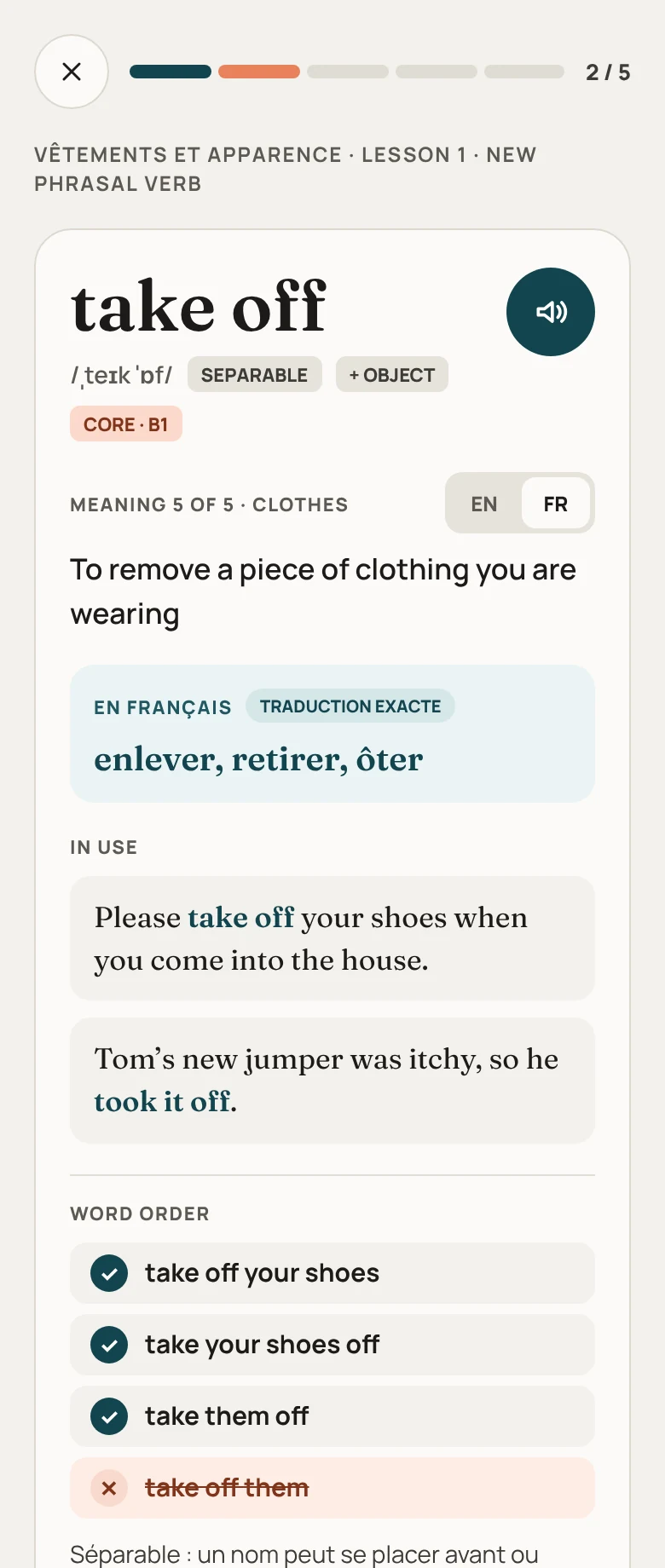
wash up
/ˌwɒʃ ˈʌp/
EN FRANÇAIS
faire la vaisselle
To clean the plates, pans and cutlery after a meal
EN FRANÇAISTRADUCTION EXACTE
faire la vaisselle
En contexte
- 1If you cook dinner tonight, I’ll wash up afterwards.
- 2We haven’t got a dishwasher, so we take turns to wash up.
- 3Ben always cooks, so his flatmate washes up after every meal.
- 4There’s a pile of dirty pans in the sink. Whose turn is it to wash up?
- 5After dinner, I washed up quickly so that we could watch the film together.
To carry something onto the beach or shore, of the sea or a river
EN FRANÇAISTRADUCTION EXACTE
rejeter (sur le rivage)
En contexte
- 1The storm washed up hundreds of shells on the beach overnight.
- 2We found an old wooden crate on the sand; the tide must have washed it up.
- 3A huge piece of driftwood lay on the sand where the waves had washed it up.
- 4After the storm, the sea washed up tonnes of plastic, which volunteers collected from the beach.
- 5Did you see the starfish that the tide washed up on the rocks this morning?
Ordre des mots
- wash up seaweed
- wash seaweed up
- wash it up
- wash up it
Séparable : un nom peut se placer avant ou après up. Un pronom (it, them, him) se place toujours entre le verbe et up.
 Phrasal Verbs
1000 phrasal verbs en 25 thèmes — avec des révisions qui les gardent en mémoire
Ici, quelques questions. Dans l’app : 16 modes d’entraînement, chaque sens sur sa propre fiche, des traductions et une répétition espacée qui vous dit quand réviser.
Bientôt disponibleiOS et Android