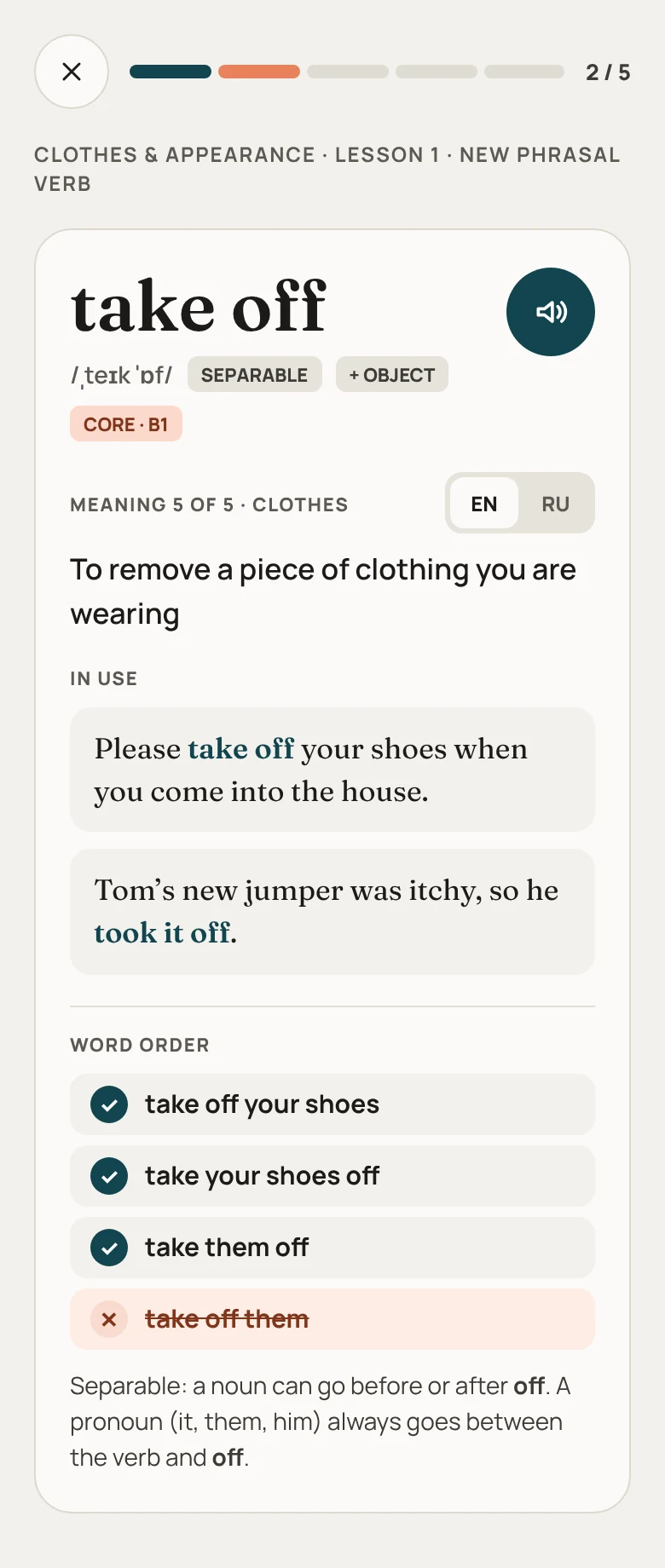
take off
/ˌteɪk ˈɒf/
To have time away from your job
In use
- 1I’m taking Friday off to go to my sister’s wedding.
- 2Nina hadn’t had a holiday all year, so she took two weeks off in August.
- 3Can I take next Monday off? I’ve got a dentist’s appointment in the morning.
- 4Tom never takes any time off, even when he’s feeling ill.
- 5We’re so busy that nobody can take more than a week off in December.
Word order
- take a day off
- take it off
- take off a day
The object always goes between the verb and off.
To leave the ground and begin to fly
In use
- 1Our plane took off an hour late because of the fog.
- 2Please keep your seatbelt fastened while the aircraft is taking off.
- 3Ten minutes after the plane took off, the crew began serving drinks.
- 4Why hasn’t our flight taken off yet? We’ve been sitting here for an hour.
- 5Small planes can’t take off when the wind is this strong.
Opposite
To suddenly become very successful or popular
In use
- 1Her small cake business really took off after a TV chef mentioned it.
- 2Nobody expected the little board game to take off, but it became the year’s top seller.
- 3His music career finally took off when one of his songs was played on national radio.
- 4Do you think electric scooters will ever take off in small towns like ours?
- 5The new sports app never really took off, so the company stopped it after a year.
Similar
catch on
To copy the way someone speaks or behaves to make people laugh
In use
- 1My brother can take off our headteacher perfectly, right down to her funny walk.
- 2Everyone laughed when Harry took his grandmother off at the family party.
- 3At the end-of-term show, Rosa took off Mr Hill so well that even he laughed.
- 4Your impressions are brilliant, so go on, take me off and let’s see how I sound!
- 5Lily takes off her old maths teacher brilliantly, especially his habit of tapping the board.
Word order
- take off the teacher
- take the teacher off
- take him off
- take off him
Separable: a noun can go before or after off. A pronoun (it, them, him) always goes between the verb and off.
To remove a piece of clothing you are wearing
In use
- 1Please take off your shoes when you come into the house.
- 2Tom’s new jumper was itchy, so he took it off.
- 3It was so warm in the restaurant that Raj took off his jacket and hung it on his chair.
- 4Do you always have to take your belt off at airport security?
- 5Aisha didn’t take off her hat, even though it was very warm in the café.
Word order
- take off your shoes
- take your shoes off
- take them off
- take off them
Separable: a noun can go before or after off. A pronoun (it, them, him) always goes between the verb and off.
Opposite
 Phrasal Verbs
1000 phrasal verbs in 25 topics — with reviews that keep them
Here you get a couple of questions. In the app: 16 practice modes, every meaning on its own card, translations and spaced repetition that tells you when to review.
Coming sooniOS and Android