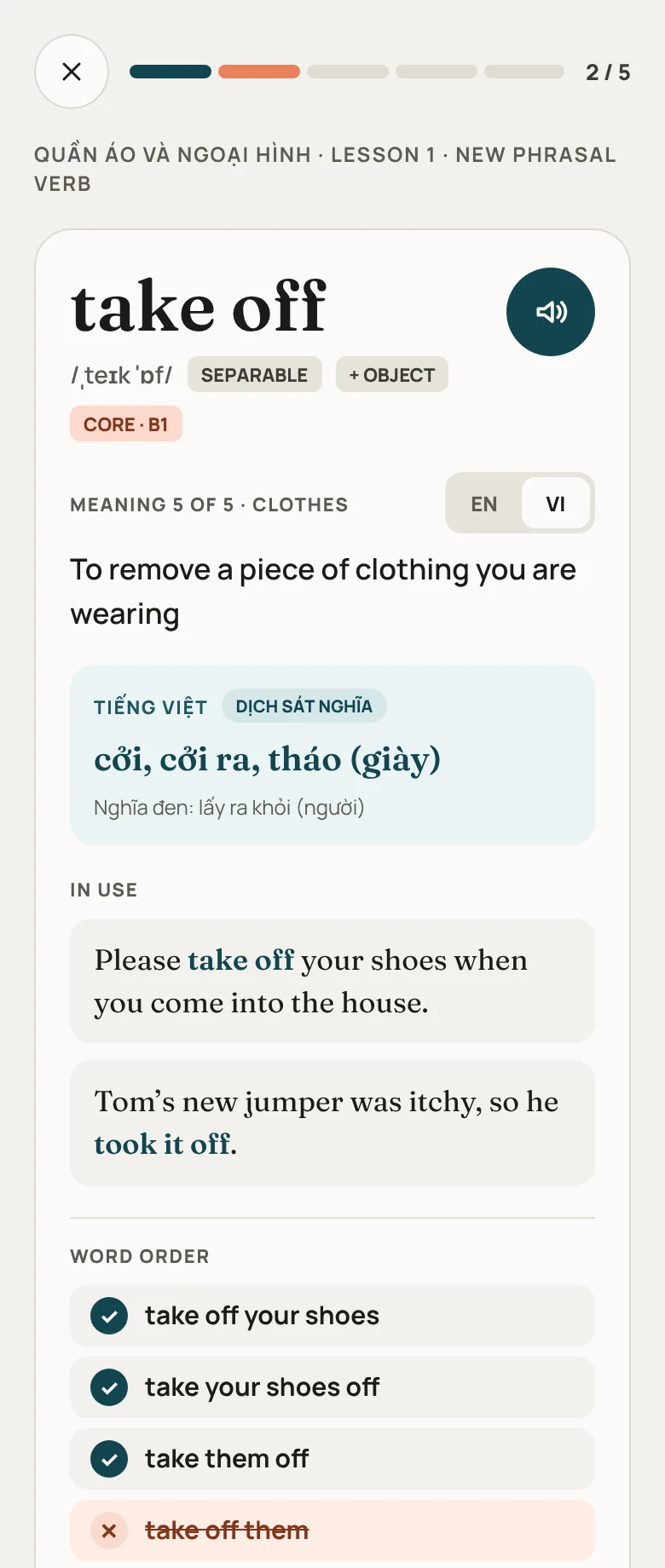
take off
/ˌteɪk ˈɒf/
TIẾNG VIỆT
nghỉ (phép), xin nghỉ
To have time away from your job
TIẾNG VIỆTDỊCH SÁT NGHĨA
nghỉ (phép), xin nghỉ
Ví dụ sử dụng
- 1I’m taking Friday off to go to my sister’s wedding.
- 2Nina hadn’t had a holiday all year, so she took two weeks off in August.
- 3Can I take next Monday off? I’ve got a dentist’s appointment in the morning.
- 4Tom never takes any time off, even when he’s feeling ill.
- 5We’re so busy that nobody can take more than a week off in December.
Trật tự từ
- take a day off
- take it off
- take off a day
Tân ngữ luôn đứng giữa động từ và off.
To leave the ground and begin to fly
TIẾNG VIỆTDỊCH SÁT NGHĨA
cất cánh
Ví dụ sử dụng
- 1Our plane took off an hour late because of the fog.
- 2Please keep your seatbelt fastened while the aircraft is taking off.
- 3Ten minutes after the plane took off, the crew began serving drinks.
- 4Why hasn’t our flight taken off yet? We’ve been sitting here for an hour.
- 5Small planes can’t take off when the wind is this strong.
Trái nghĩa
To suddenly become very successful or popular
TIẾNG VIỆTDỊCH SÁT NGHĨA
ăn khách, cất cánh, phất lên
Ví dụ sử dụng
- 1Her small cake business really took off after a TV chef mentioned it.
- 2Nobody expected the little board game to take off, but it became the year’s top seller.
- 3His music career finally took off when one of his songs was played on national radio.
- 4Do you think electric scooters will ever take off in small towns like ours?
- 5The new sports app never really took off, so the company stopped it after a year.
Gần nghĩa
catch on
To copy the way someone speaks or behaves to make people laugh
TIẾNG VIỆTDỊCH SÁT NGHĨA
nhại ai đó, bắt chước ai đó (cho vui)
Ví dụ sử dụng
- 1My brother can take off our headteacher perfectly, right down to her funny walk.
- 2Everyone laughed when Harry took his grandmother off at the family party.
- 3At the end-of-term show, Rosa took off Mr Hill so well that even he laughed.
- 4Your impressions are brilliant, so go on, take me off and let’s see how I sound!
- 5Lily takes off her old maths teacher brilliantly, especially his habit of tapping the board.
Trật tự từ
- take off the teacher
- take the teacher off
- take him off
- take off him
Tách được: danh từ có thể đứng trước hoặc sau off. Đại từ (it, them, him) luôn đứng giữa động từ và off.
To remove a piece of clothing you are wearing
TIẾNG VIỆTDỊCH SÁT NGHĨA
cởi, cởi ra, tháo (giày)
Nghĩa đen: «lấy ra khỏi (người)»
Ví dụ sử dụng
- 1Please take off your shoes when you come into the house.
- 2Tom’s new jumper was itchy, so he took it off.
- 3It was so warm in the restaurant that Raj took off his jacket and hung it on his chair.
- 4Do you always have to take your belt off at airport security?
- 5Aisha didn’t take off her hat, even though it was very warm in the café.
Trật tự từ
- take off your shoes
- take your shoes off
- take them off
- take off them
Tách được: danh từ có thể đứng trước hoặc sau off. Đại từ (it, them, him) luôn đứng giữa động từ và off.
Trái nghĩa
 Phrasal Verbs
1000 phrasal verb trong 25 chủ đề — với lượt ôn tập giúp bạn không quên
Ở đây chỉ có vài câu hỏi. Trong ứng dụng có 16 chế độ luyện tập, mỗi nghĩa một thẻ riêng, bản dịch tiếng Việt và lặp lại ngắt quãng nhắc bạn khi nào cần ôn.
Sắp ra mắtiOS và Android