take on
/ˌteɪk ˈɒn/
To start to employ someone
In use
- 1The café is taking on extra staff for the summer.
- 2We liked the trainee so much that we took her on full-time.
- 3The factory has won a big order and will take on forty new workers.
- 4He did so well in his month’s trial that the bakery decided to take him on permanently.
- 5The shop is so busy that the manager wants to take on two more assistants.
Word order
- take on new staff
- take new staff on
- take them on
- take on them
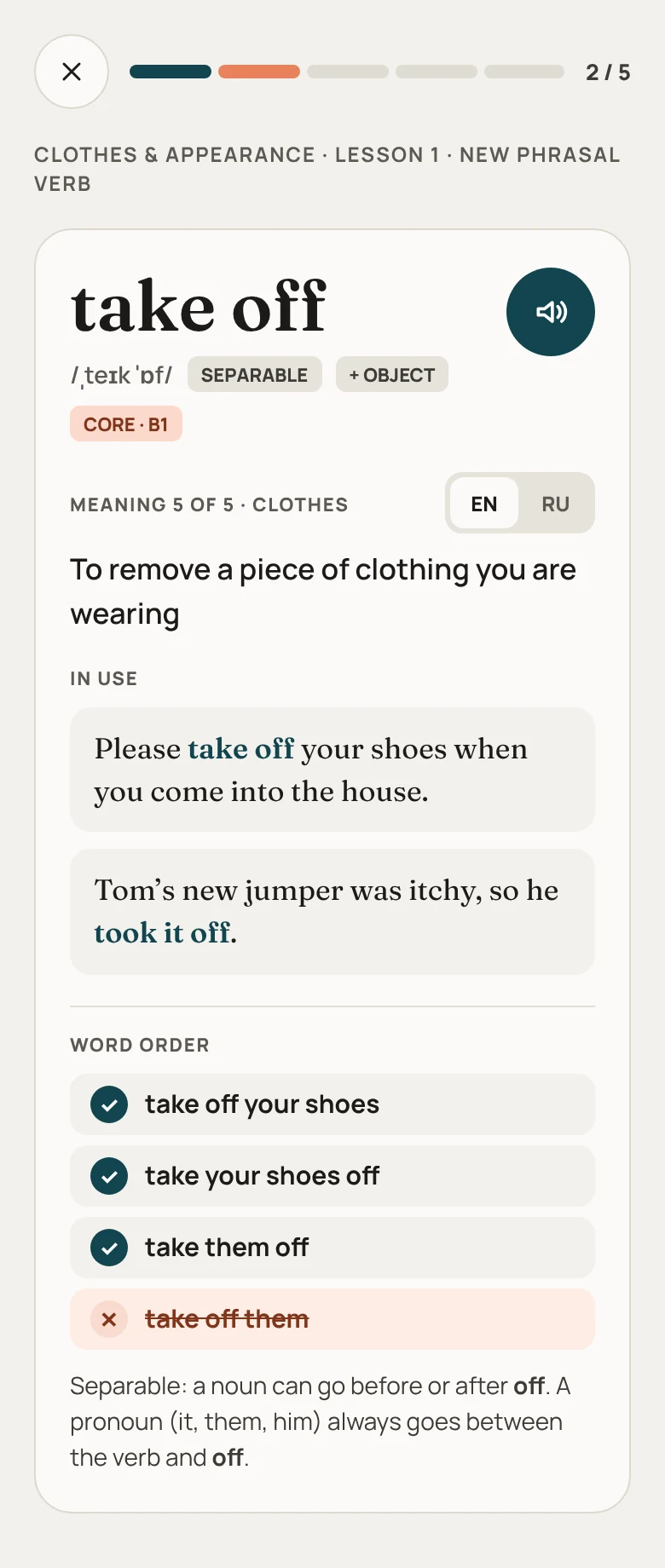
Separable: a noun can go before or after on. A pronoun (it, them, him) always goes between the verb and on.
Opposite
To play or compete against someone
In use
- 1Our hockey team takes on the league champions next Tuesday.
- 2My brother says he’s the best at table tennis, so I took him on last night.
- 3In the next round, we’ll take on a team from the top division.
- 4Tom was nervous about taking on such a strong opponent in his first tournament.
- 5Nobody wanted to play the champions, but Aisha said she would take them on.
Word order
- take on the champions
- take the champions on
- take them on
- take on them
Separable: a noun can go before or after on. A pronoun (it, them, him) always goes between the verb and on.
 Phrasal Verbs
1000 phrasal verbs in 25 topics — with reviews that keep them
Here you get a couple of questions. In the app: 16 practice modes, every meaning on its own card, translations and spaced repetition that tells you when to review.
Coming sooniOS and Android