take in
To let someone stay in your home because they have nowhere else to live
Paano ginagamit
- 1When Rosa’s house flooded, her neighbours took her in for a month.
- 2Over the years, the couple have taken in several foster children.
- 3My grandparents took in a homeless student who had nowhere to stay.
- 4The kitten was so thin and wet that we decided to take it in.
- 5Would you take in a friend who had lost both his flat and his job?
Word order
- take in her nephew
- take her nephew in
- take him in
- take in him
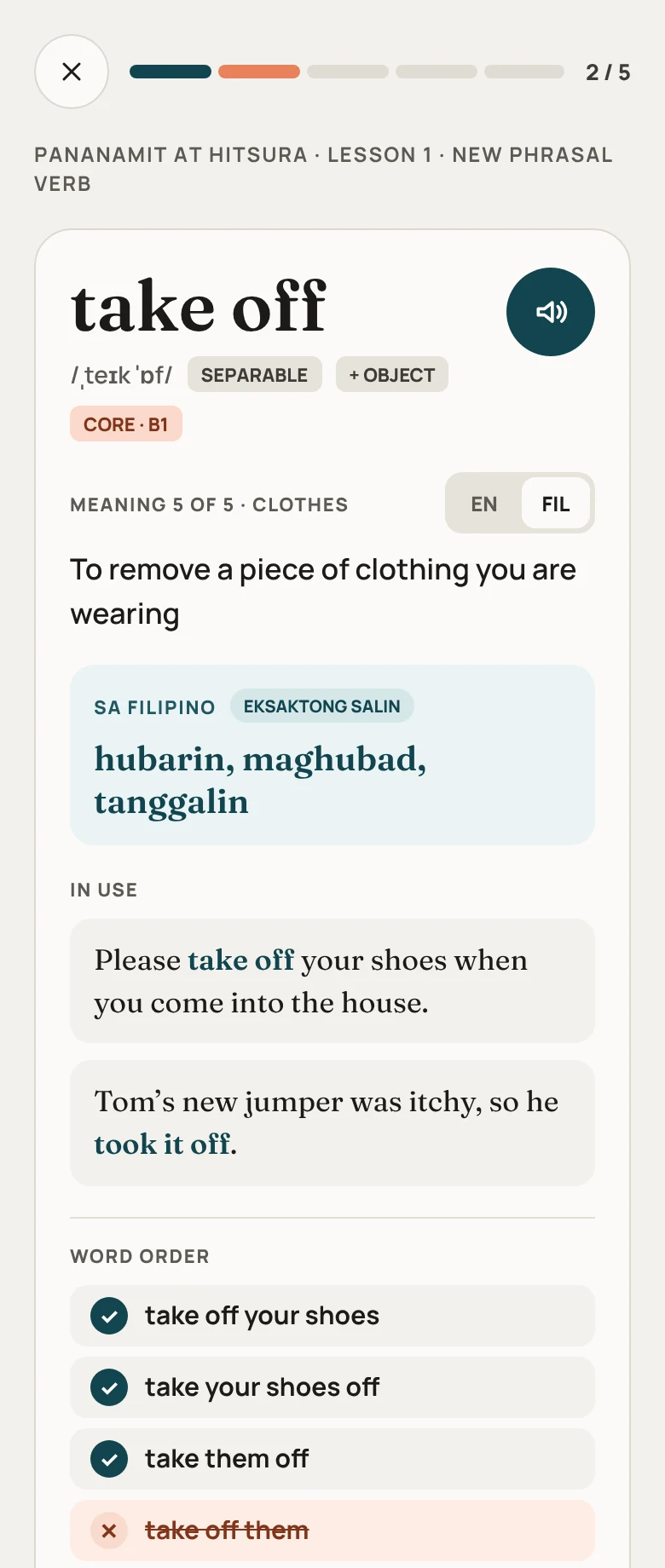
Mapaghihiwalay: ang noun ay maaaring ilagay bago o pagkatapos ng in. Ang pronoun (it, them, him) ay laging nasa pagitan ng verb at ng in.
To visit or include a place as part of a trip
Paano ginagamit
- 1Our week in Scotland took in Edinburgh, Stirling and the Isle of Skye.
- 2The cathedral was a short walk away, so we took it in on our way to the station.
- 3The coach tour takes in three castles and a lakeside village in a single day.
- 4Is it possible to take in the old harbour before our ferry leaves?
- 5The museum sounds wonderful, so let’s take it in tomorrow morning before we drive to York.
Word order
- take in the castle
- take the castle in
- take it in
- take in it
Mapaghihiwalay: ang noun ay maaaring ilagay bago o pagkatapos ng in. Ang pronoun (it, them, him) ay laging nasa pagitan ng verb at ng in.
To understand and remember new information
Paano ginagamit
- 1There was so much on the slides that I couldn’t take it all in.
- 2The lecture was so fast that most of us didn’t take in half of what the professor said.
- 3It was a long lesson, and Leo was too tired to take in any more grammar.
- 4Can you repeat the instructions more slowly? I didn’t take them in the first time.
- 5After eight hours of revision, my brain simply couldn’t take in anything else.
Word order
- take in the information
- take the information in
- take it in
- take in it
Mapaghihiwalay: ang noun ay maaaring ilagay bago o pagkatapos ng in. Ang pronoun (it, them, him) ay laging nasa pagitan ng verb at ng in.
To make a piece of clothing narrower or tighter
Paano ginagamit
- 1I’ve lost weight, so I need to take in all my work trousers.
- 2The dress was too loose around the waist, so my aunt took it in for me.
- 3Could you take in this skirt a little at the waist? It keeps slipping down my hips.
- 4My new jeans were baggy at the back, so the tailor took them in for free.
- 5Before the wedding, could you take in the jacket so it doesn’t look so baggy?
Word order
- take in the dress
- take the dress in
- take it in
- take in it
Mapaghihiwalay: ang noun ay maaaring ilagay bago o pagkatapos ng in. Ang pronoun (it, them, him) ay laging nasa pagitan ng verb at ng in.
 Phrasal Verbs
1000 phrasal verbs sa 25 paksa — may review para hindi mo makalimutan
Dito, ilang tanong lang. Sa app, may 16 na practice mode, sariling card para sa bawat kahulugan, salin sa Filipino at spaced repetition na nagsasabi kung kailan ka dapat mag-review.