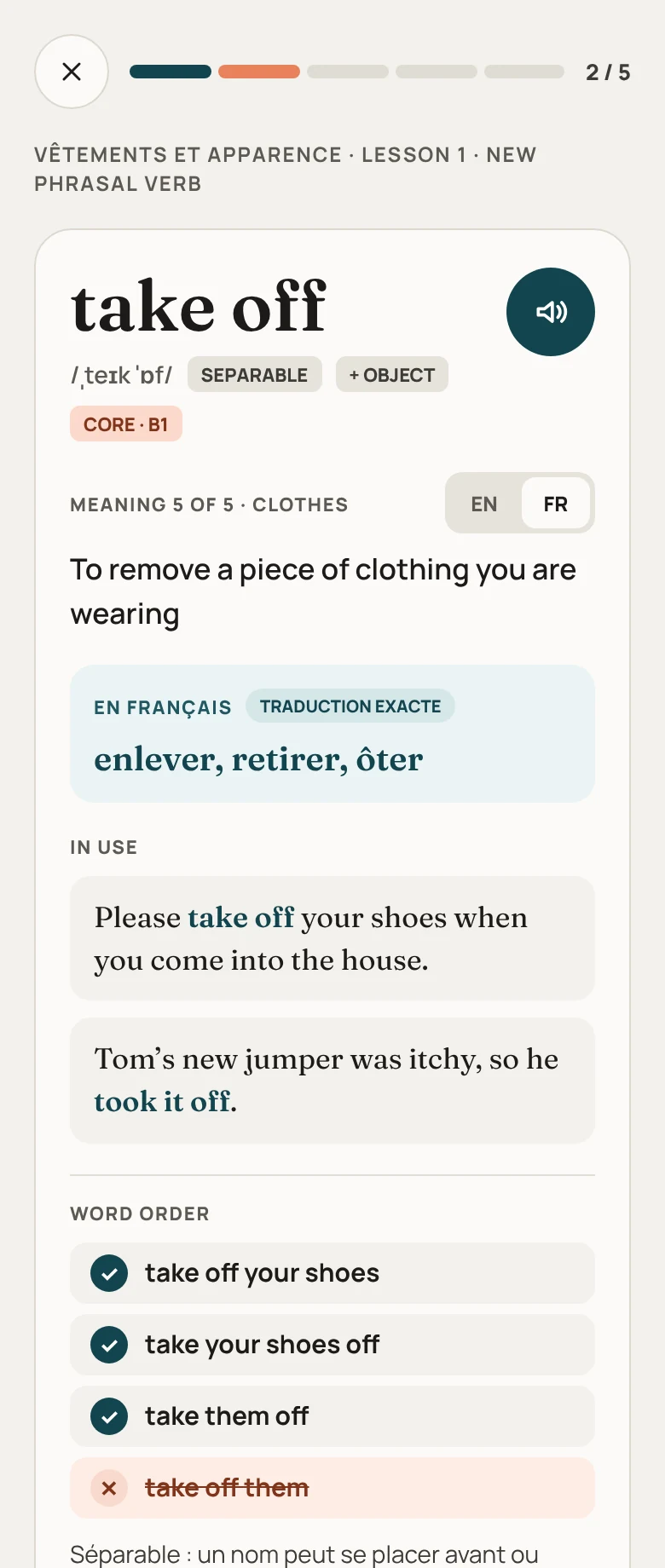
bring on
/ˌbrɪŋ ˈɒn/
EN FRANÇAIS
provoquer, déclencher
To make an illness or a medical problem start
EN FRANÇAISTRADUCTION EXACTE
provoquer, déclencher
En contexte
- 1Stress can bring on headaches in some people.
- 2Lily gets asthma attacks, and running in cold air often brings them on.
- 3In spring, Aisha’s hay fever is often brought on by freshly cut grass.
- 4Ben has a migraine again. Do you know what brought it on?
- 5The doctor asked whether anything special had brought on the chest pains.
Ordre des mots
- bring on a headache
- bring a headache on
- bring it on
- bring on it
Séparable : un nom peut se placer avant ou après on. Un pronom (it, them, him) se place toujours entre le verbe et on.
To send a player onto the field during a game
EN FRANÇAISTRADUCTION EXACTE
faire entrer (en jeu)
En contexte
- 1The manager brought on a fresh striker for the last ten minutes.
- 2Our goalkeeper was injured, so the coach brought me on at half-time.
- 3With ten minutes left, the coach brought on a young striker from the bench.
- 4I’ve been waiting all game, so will you bring me on for the last five minutes?
- 5Why didn’t the manager bring on the new signing until the eighty-fifth minute?
Ordre des mots
- bring on a substitute
- bring a substitute on
- bring him on
- bring on him
Séparable : un nom peut se placer avant ou après on. Un pronom (it, them, him) se place toujours entre le verbe et on.
 Phrasal Verbs
1000 phrasal verbs en 25 thèmes — avec des révisions qui les gardent en mémoire
Ici, quelques questions. Dans l’app : 16 modes d’entraînement, chaque sens sur sa propre fiche, des traductions et une répétition espacée qui vous dit quand réviser.
Bientôt disponibleiOS et Android