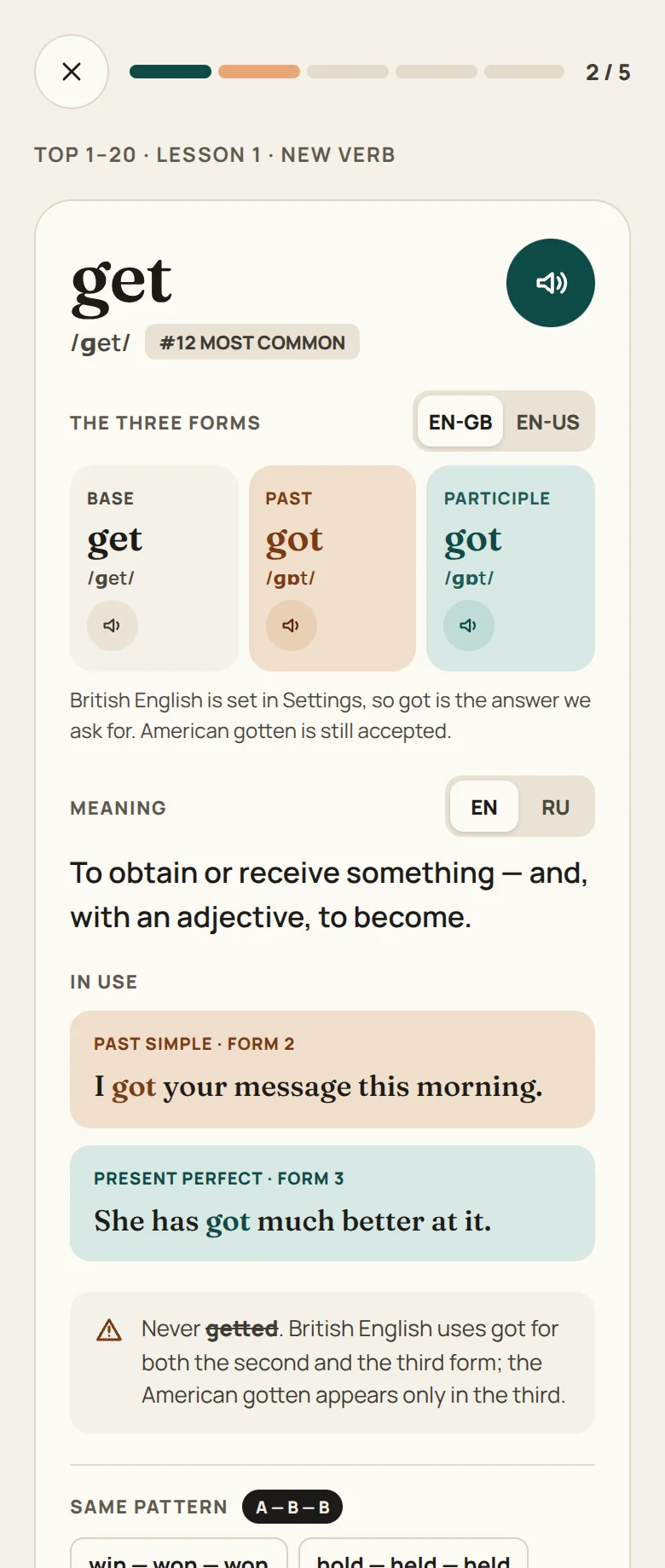
bear
Base verbale
bear
/beə(r)//ber/
Prétérit
bore
/bɔː(r)//bɔːr/
Participe passé
borne
/bɔːn//bɔːrn/
TraductionB2
supporter, endurer
to grin and bear it
Sens en anglais
to accept something unpleasant; to carry weight
Exemples
- Après un modal · Forme 1I can’t bear the noise from the flat upstairs any longer.
- Négation · Forme 1She doesn’t bear grudges, even after a big argument.
- Prétérit · Forme 2Last winter Grandpa bore the pain of his bad knee without complaining.
- Prétérit · Forme 2The old bridge bore the weight of the lorry yesterday, but only just.
- Passif · Forme 3All the costs of the repair will be borne by the landlord.
- Present perfect · Forme 3He has borne most of the blame for the defeat.
Attention
Pour un bébé, on dit born ; sinon, c'est borne : costs borne by the council. Le prétérit est bore : she bore the pain.
 Irregular Verbs
Retenez les trois formes pour de bon
De courtes leçons par fréquence ou par modèle, l’audio de chaque forme et des révisions quotidiennes qui ramènent justement les verbes que vous êtes en train d’oublier.

 Installer sur votre téléphoneScannez avec l’appareil photo de votre téléphone pour télécharger l’app