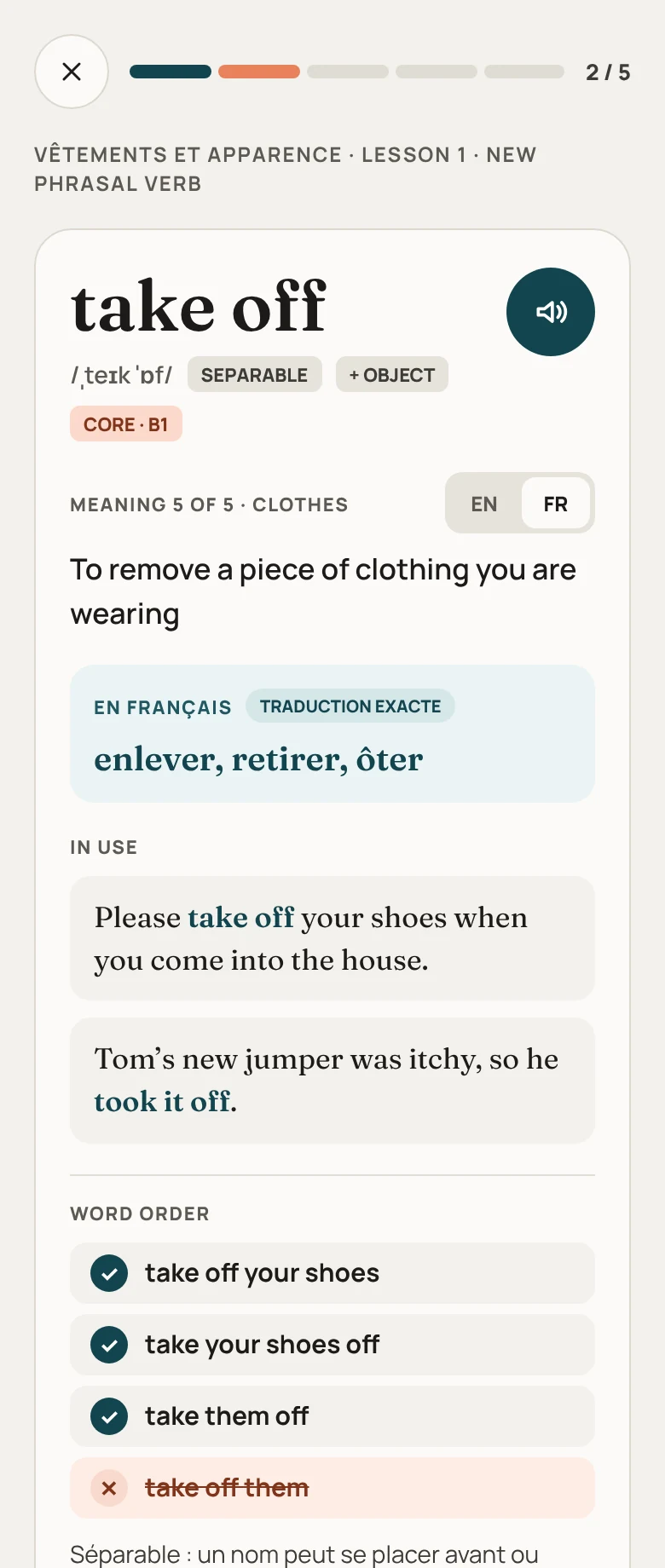
bring up
/ˌbrɪŋ ˈʌp/
EN FRANÇAIS
élever
To care for a child until they are an adult
EN FRANÇAISTRADUCTION EXACTE
élever
En contexte
- 1My grandparents brought me up after my parents moved abroad for work.
- 2It isn’t easy to bring up three children on one salary.
- 3Leo was brought up by his aunt and went to school in a small village.
- 4They brought their son up to say please and thank you.
- 5It must be really hard work bringing up twins on your own.
Ordre des mots
- bring up the children
- bring the children up
- bring them up
- bring up them
Séparable : un nom peut se placer avant ou après up. Un pronom (it, them, him) se place toujours entre le verbe et up.
To start talking about a particular subject
EN FRANÇAISTRADUCTION EXACTE
aborder, soulever, évoquer
En contexte
- 1Tom brought up the subject of money during dinner with his parents.
- 2I wanted to ask about a pay rise, but I was too nervous to bring it up.
- 3Please don’t bring up politics when my grandparents come for lunch on Sunday.
- 4Ben has an idea about the new timetable and will bring it up at Monday’s meeting.
- 5Why did you have to bring up my old school reports in front of everyone?
Ordre des mots
- bring up the subject
- bring the subject up
- bring it up
- bring up it
Séparable : un nom peut se placer avant ou après up. Un pronom (it, them, him) se place toujours entre le verbe et up.
To make information appear on a computer screen
EN FRANÇAISTRADUCTION EXACTE
afficher, ouvrir
En contexte
- 1The doctor brought up my test results on her computer.
- 2I can’t remember the address, but I’ll bring it up on my phone.
- 3Could you bring up last month’s sales figures on the big screen so everyone can see them?
- 4Ask the receptionist and she’ll bring your booking up on her screen.
- 5Nobody could find the email, so Raj brought it up on his laptop and read it aloud.
Ordre des mots
- bring up the file
- bring the file up
- bring it up
- bring up it
Séparable : un nom peut se placer avant ou après up. Un pronom (it, them, him) se place toujours entre le verbe et up.
 Phrasal Verbs
1000 phrasal verbs en 25 thèmes — avec des révisions qui les gardent en mémoire
Ici, quelques questions. Dans l’app : 16 modes d’entraînement, chaque sens sur sa propre fiche, des traductions et une répétition espacée qui vous dit quand réviser.
Bientôt disponibleiOS et Android